Thursday, 27 January 2011

For Additional Math Class - Grade 9

Answer of Exercise 3.5
1. (a) None (b) One (c) Infi nite (d) One (e) None
2. (a) x = 8, y = 13 (b) x = 11/5 ; y = 2/5 (c) x = 1/17 , y = - 5/17
3. Peter is 15, Anneka is 9

Additional Questions

  1. A coach travels along the M3 from Winchester to London. It sets off at 10.30 a.m and travels at a constant speed of 65 mph. A car makes the same journey, travelling 10 mph faster but leaving 5 minutes later. When does the car overtake the coach?
  2. Andrea is trying to save money on electricity bills. at present she estimates her family uses 8000 units of electricity per year at 6.59 cent per unit. They also have to pay an annual standing charge of $36.28. She is told that installing an ' Economic 7' system might save money. This mean that off-peak units are charged at 2.63 cent per unit and the rest at 6.59p, but there is an additional annual standing charge of $10.04. She wants to know how many of the 8000 units would have to be off-peak units in order to save at least $50 per year. Solve her problem.

Wednesday, 10 November 2010

Understanding Hydraulic System

A hydraulic system operates based on Pascal's principle.

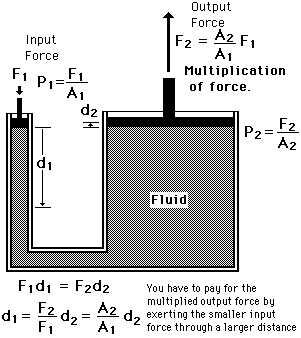
In this hydraulic system, a small force, F1 is applied to the small piston resulting in a large force , F2 at the piston K. The pressure, due to the force, F1, is transmitted by the liquid to the large piston.

Pressure, P = F1/A1

This pressure is transmitted through the liquid and acts on the base of the large piston.

Force on the large piston, F2 = P X A2 = (F1/A1) X A2.

The large force causes the load to rise.

Also F2/F1 = A2/A1

Output force / input force = output piston area / input piston area

Because of the much larger surface area, A2 of the piston K compared to the surface area, A1 of the piston, the resultant force, F1.


This shows that a large force can be produced by a small force, using Pascal's principle.

Hydraulic systems act as a force multiplier where A2/A1 is the multiplying factor.

For example, if A2=5A1, then F2 = 5F1

since F2 = F1 X (A2/A1)

A hydraulic system must not contain any air bubbles in any portion of its hydraulic fluid system.
The presence of air bubbles in the hydraulic fluid system will reduce the efficiency of the system as part of the applied force will be used to compress the air bubbles.

Understanding Displacement, Speed and Acceleration

Distance and Displacement

Distance is the total path length traveled from one location to another. It is a scalar quantity.

Displacement is the distance between two locations measured along the shortest path connecting them, in specified location. It is a vector quantity. The SI unit of distance and displacement is metre (m).


Speed and Velocity


Speed is the distance traveled per unit time or the rate of change of distance.

Speed = total distance traveled / time taken

Velocity is the speed in a given direction or the rate of change of displacement.

Average velocity = displacement/ time taken


Acceleration and Deceleration

Acceleration is the rate of change of velocity.

Acceleration = change of velocity / time taken

Change of velocity = final velocity (v) – initial velocity (u)

Acceleration = (final velocity – initial velocity) / time taken = (v – u) / t


Things to remember:

1. Constant velocity means the object is not accelerating. Acceleration is zero.

2. Constant acceleration means the object is increasing its velocity.

Understanding Work and Energy

Work
1. Work is defined as the product of the applied force and the displacement of an object in the direction of the applied force.
2. W = F x d
3. W= work done, F = force applied, d = displacement in the direction of force.
4. SI unit for work = Joule (J), other unit = Nm
5. Work is not done when:
  • The object is stationary or not moving
  • No force is applied on the object in the direction of displacement.
  • The direction of motion of the object is perpendicular to that of the applied force.
6. When work is done to an object, energy is transferred to the object.


Energy (Energy is the capacity to do work)
1. Energy exists in different forms: kinetic energy, gravitational potential energy, elastic potential energy, sound energy, heat energy, light energy, electrical energy and chemical energy.
2. The unit for energy is Joule (J) – same as work
3. The work done is equal to the amount of energy transferred.
4. Kinetic energy is the energy of an object due to its motion.
5. Kinetic energy or work done is given by:
  • a. ½ mv2
  • b. M = mass, v = velocity
  • c. Unit: Joule
6. Gravitational potential energy is the energy of an object due to its higher position in the gravitational field.
  • E = mgh
  • M = mass, g = acceleration due to gravity, h = height in metre

Understanding Scalar and Vector quantities

Scalar quantities: Quantities that have magnitude only. ( Speed, mass, distance)

Example:

For example speed has unit of ms^-1. but it has no direction.

Mass is kg but we don't know the direction.

Distance is 2km but no direction.

Vector quantities: Quantities that have magnitude and direction. (Velocity, Weight, Displacement)

Example:

Velocity unit is ms^-1 but we must state the direction that is whether from right to left.

Weight unit is Kg but the direction is towards the gravity pull of the earth.

Displacement is 2km but to the north from the point of reference.